
How Evie and Paradox compare on candidate coordination
Paradox's Olivia and Evie both use conversational AI, but they were built for different hiring problems — high-volume frontline conversations versus complex multi-party coordination. Here's a full breakdown, especially now that Paradox is part of Workday.
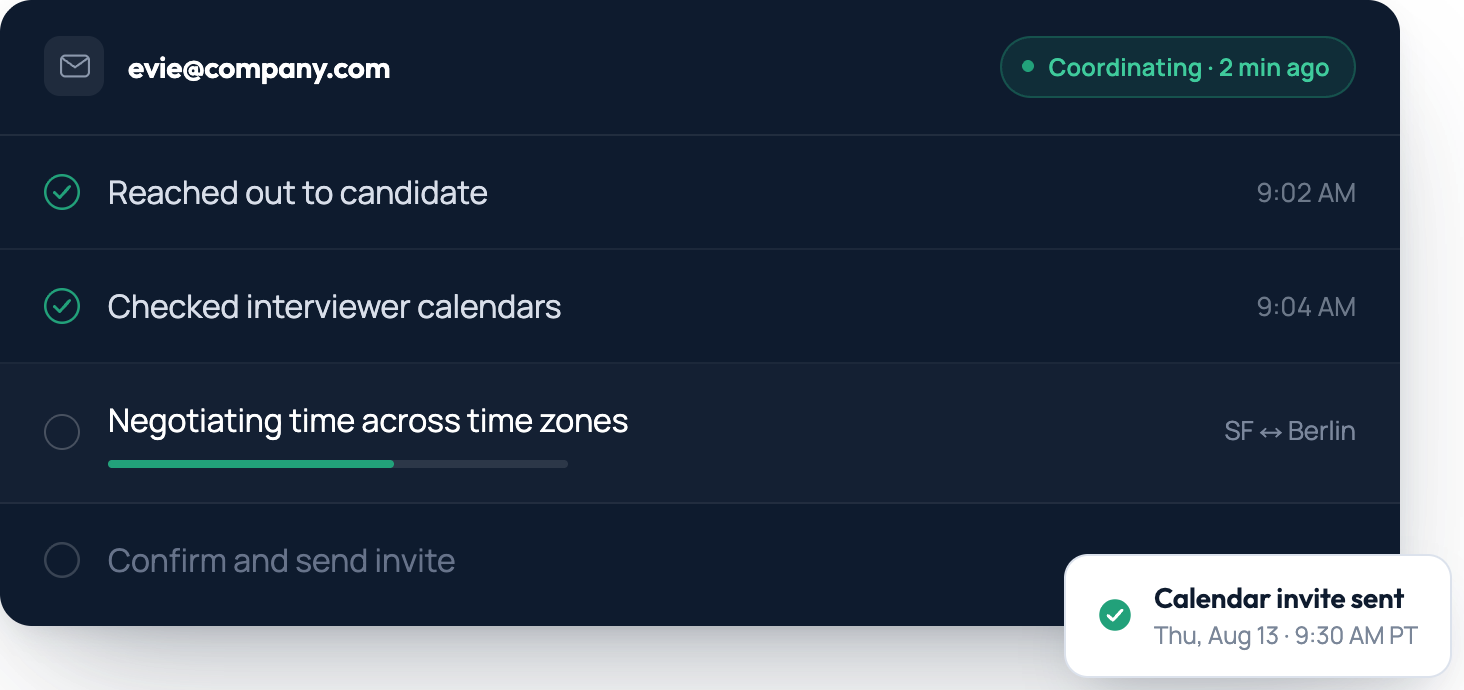
Evie is an AI Employee for talent operations, handling scheduling and coordination over natural email and SMS conversation. It's purpose-built for multi-format interviews — panels, pools, batch, and multi-stage sequences — across time zones, with the reasoning to negotiate directly when things change rather than escalating to a human.
Evie's roadmap is dedicated entirely to talent operations coordination.
Paradox built Olivia as a conversational AI assistant focused on high-volume, frontline, and hourly hiring — screening candidates, answering FAQs, and instantly scheduling interviews via text. It has powered a very large volume of AI-assisted candidate conversations for employers like Chipotle, 7-Eleven, and Nestlé.
Following Workday's acquisition (closed October 1, 2025, for approximately $1.1B), Olivia is being integrated into Workday's talent acquisition suite as its candidate experience agent, meaning its future development will sit alongside Workday's broader HCM roadmap rather than as a standalone product.
What each platform does best.
Evie
- Complex coordination, natively
Panels, pools, batch, and multi-stage sequences across time zones.
- Autonomous reasoning
Negotiates directly with candidates and interviewers on ambiguous or changing availability.
- Anti-reschedule design
50% fewer reschedules and 10x faster scheduling than manual processes.
- Independent roadmap
Built and prioritized specifically for talent operations coordination.
- Ecosystem-flexible integrations
Microsoft 365, SAP SuccessFactors, and other enterprise systems, regardless of core HRIS.
Paradox (Olivia)
- High-volume conversational screening
Text-based Q&A, FAQ answering, and self-scheduling at scale.
- Frontline/hourly hiring focus
Proven at large employers with high-turnover, high-volume roles.
- Fast, simple scheduling
Effective for straightforward 1:1 interview booking.
- Workday-native integration
Deepest value for organizations already standardized on Workday.
- Multi-language support
Built to operate across a large number of languages for global, high-volume hiring.
How each is priced.
Custom, quote-based pricing scaled to hiring volume and complexity. Request a demo for a quote specific to your team.
Historically custom enterprise pricing that isn't publicly disclosed, sold through a demo/sales process. As part of Workday, future pricing and packaging will likely be shaped by how it's bundled into Workday's talent acquisition suite — worth confirming directly given the recent acquisition.
Evie vs. Paradox (Olivia)
| Evie | Paradox (Olivia) | |
|---|---|---|
| Ownership & focus | Independent, purpose-built for talent operations coordination | Acquired by Workday (closed Oct 2025, ~$1.1B); integrated into Workday's talent acquisition suite |
| Core strength | Complex, multi-party coordination — panels, pools, sequences | High-volume conversational screening and scheduling, frontline/hourly hiring |
| Reschedule performance | 50% fewer reschedules, 10x faster scheduling (Evie benchmark) | Automated rescheduling and reminders, reactive to changes |
| Interview complexity | Native panels, pools, batch, multi-stage sequences, time zones | Strongest for 1:1 and simpler high-volume scheduling |
| Roadmap | Dedicated to talent operations coordination | Set within Workday's broader HCM suite priorities |
| Deployment flexibility | Integrates across HRIS platforms | Deepest value inside the Workday ecosystem |
| Pricing | Custom quote, scaled to team size | Custom enterprise pricing, historically undisclosed |
When Evie is the better fit.
If your hiring involves multi-person, multi-format coordination.
Paradox's strength has always been high-volume, relatively simple scheduling conversations — a good fit for frontline and hourly hiring. Evie is built for the harder version of the problem: panels, pools, and sequences across time zones, with the judgment to negotiate when things change.
If you don't want your coordination roadmap tied to one HRIS vendor.
Now that Olivia is part of Workday, its deepest integration value and future development will reasonably prioritize Workday customers first, as one part of a much larger HCM portfolio. Evie integrates across Microsoft 365, SAP SuccessFactors, and other systems, and its roadmap has one focus.
When Paradox (Olivia) may suit you better.
If you're already standardized on Workday and hire high-volume, hourly, or frontline roles.
Paradox has an extensive track record here — conversational screening and scheduling at scale, with named results like faster time-to-hire for large retail and service employers. Native Workday integration is a legitimate reason to stay in that ecosystem.
If simplicity matters more than coordination depth.
For straightforward 1:1 scheduling at high volume, Paradox's conversational approach is proven and low-friction.
“I've heard multiple vendors refer to Evie as if it were real, talking about how great it did scheduling around everyone's calendar, planning the meeting and even rescheduling if needed.”
Questions teams ask.
See if Evie fits how your team hires
Bring Evie into your inbox and let your team focus on what only humans can do — pick great people.